
By Peggy Pliscott, SMP Artist at Precision Scalp
You’ve seen the before and after photos, but you’re still asking the real question: will it actually look like a shaved head, or will people be able to tell? That’s fair. This is your scalp and your hairline, and you deserve a straight answer before you book a consultation, not a sales pitch.
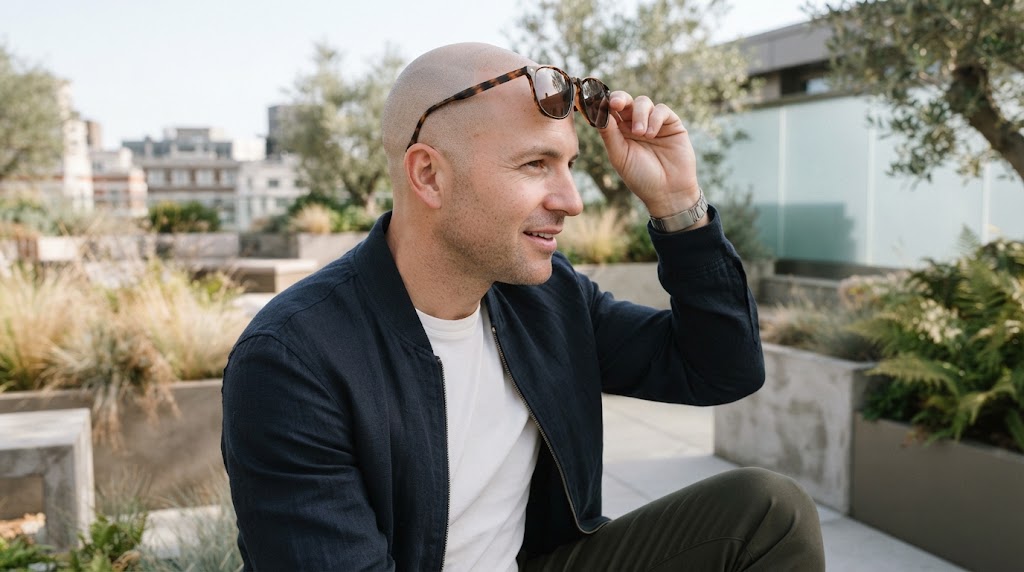
A shaved head SMP result, once fully healed, looks like a closely cropped head of hair with visible density and a defined but soft hairline, created by depositing pigment in a stippling pattern across the scalp. That’s the direct answer. The rest of this comes down to how that density is built, session by session, and what your scalp looks like while you’re getting there.
How the dot pattern creates the illusion of a shaved head
The technique behind this isn’t guesswork. Pigment is deposited using an electric needle device cycling at speed, placing dots at a shallow depth in the upper layer of the scalp, roughly 1.5 to 2 millimetres deep. That precision matters: too deep and dots blur or migrate; too shallow and they fade within months.
Density is built gradually. Early sessions might place around 40 dots per square centimetre. By the final session, that density typically climbs to 80 or even 100 dots per square centimetre, which is what gives a shaved head its convincing depth rather than a flat, painted-on look. A single session can involve tens of thousands of individual pigment dots across the scalp.
Needle choice changes by zone too. The hairline is worked with a fine single-point needle, because that’s where precision and softness matter most. The crown, temples and back of the head use a slightly broader triple-point needle, since these areas need to read as dense coverage rather than crisp definition.
What the hairline and colour match should look like healed
A well-executed hairline doesn’t sit in a straight line. Real hairlines are irregular, with slightly varied density and a soft, feathered edge rather than a hard border. If your SMP hairline looks like it was drawn with a ruler, that’s a sign of inexperience, not a design choice.
Colour matching is where a lot of the “does this look real” question gets answered. Pigment is mixed to match your natural hair colour, and for most people that also means accounting for some grey blending in later years, since black pigment on a scalp reads very differently once your remaining hair silvers. A skilled practitioner will test pigment tone against your skin undertone as well as your hair colour, because scalp pigmentation that looks perfect in October can look slightly off by comparison the following summer if skin tone shifts with sun exposure.
Here’s the honest caveat: healed SMP is not identical to a real buzz cut under a magnifying glass. Dots are more uniform than actual follicles, which grow at slightly different angles and thicknesses. From a normal viewing distance, in normal light, on a normal day, nobody clocks the difference. Up close under a bright bathroom light with someone specifically looking for it, a trained eye might spot a pattern that’s almost too regular. That’s the realistic bar, not a mystical guarantee.
How many sessions you actually need and what happens in between
For most density or shaved-look SMP work, you’re looking at 3 to 4 sessions minimum, spaced two to four weeks apart. This isn’t an arbitrary number. Each session builds on the last, adding density and refining the hairline while giving your scalp time to heal and settle so pigment can be assessed accurately once swelling and redness have gone down.
Between sessions, your scalp will look patchy, lighter than the previous session and, honestly, a bit unfinished. That’s normal and expected, not a sign anything’s gone wrong. The first session lays foundation density; the second and third build depth and correct any areas that faded unevenly; the fourth, if needed, refines and perfects. Trying to judge the final result after session one is like judging a painting after the underpainting.
Each appointment typically runs one to five hours depending on the area covered. Immediately after a session, your scalp will look redder and darker than the healed result, sometimes noticeably so. Expect that initial redness to calm within two to three days, with the scalp settling into its true tone over the following weeks.
Healing timeline and what to expect week by week
Days 1 to 4 after each session: no water on the scalp, no shampoo, no sweating, no shaving. Your scalp needs this window to form a light protective layer while pigment settles.
Days 5 to 10: you can introduce gentle washing, but sun exposure is still off the table. From day 10 onward, you can apply SPF to the scalp and return to normal grooming. Full healing, meaning pigment has properly settled and the scalp has fully recovered, takes around 30 days per session. Swimming pools should be avoided for a full 28 days after treatment, since chlorine can interfere with pigment settling.
Once fully healed, most people find their shaved head SMP holds its density and colour well for four to eight years before a touch-up is worth considering, typically every four to six years. Sun exposure, skin oiliness and skin turnover speed all affect how quickly pigment softens over time, which is why SPF on the scalp becomes a genuine long-term habit, not just a healing-phase instruction.
Who this suits and who should look elsewhere first
Shaved head SMP works well for male and female pattern hair loss, alopecia, scarring from previous transplants, and scalp scars you’d rather not see highlighted by a shave. It is not suitable if you have active scalp acne, a psoriasis flare, eczema, or a history of keloid scarring, since pigment placement on inflamed or reactive skin carries real risk.
It’s worth saying plainly: SMP does not regrow hair or change what’s happening underneath the scalp. It camouflages the contrast between skin and hair by recreating the visual pattern of a closely shaved head. If you’re researching SMP options, ask specifically how many sessions a practitioner recommends for your case and why, not just for a total price. A practitioner who gives you a one-session quote for full shaved-head density is skipping a step your scalp will notice later.
Frequently Asked Questions
What does a shaved head look like immediately after SMP compared to a month later?
Immediately after a session, the scalp looks darker and redder than the final result, because pigment sits closer to the surface and skin is mildly inflamed. Over the following month, redness fades, pigment settles into the upper dermis, and the true colour and density become visible.
How many SMP sessions are needed for a full shaved head look?
Most shaved head density work requires 3 to 4 sessions, spaced two to four weeks apart. Each session builds density and refines the hairline, so judging the result before the final session is finished won’t reflect the actual healed outcome.
Will SMP look exactly like a real buzz cut?
From normal viewing distance and lighting, yes, it reads convincingly as a shaved head. Up close under bright light, dots are slightly more uniform than real follicles, so it’s a close, confident match rather than a microscopic replica.
What does the scalp look like between SMP sessions?
Between sessions the scalp typically looks patchy and lighter than the previous appointment, since density is built gradually across multiple visits. This unfinished appearance is expected and resolves as later sessions add depth and even out tone.
How long does a shaved head SMP result last before it fades?
Most shaved head SMP results last four to eight years before noticeable fading, with touch-ups typically recommended every four to six years. Sun exposure, skin oiliness and natural skin turnover all influence how quickly pigment softens over that timeframe.