
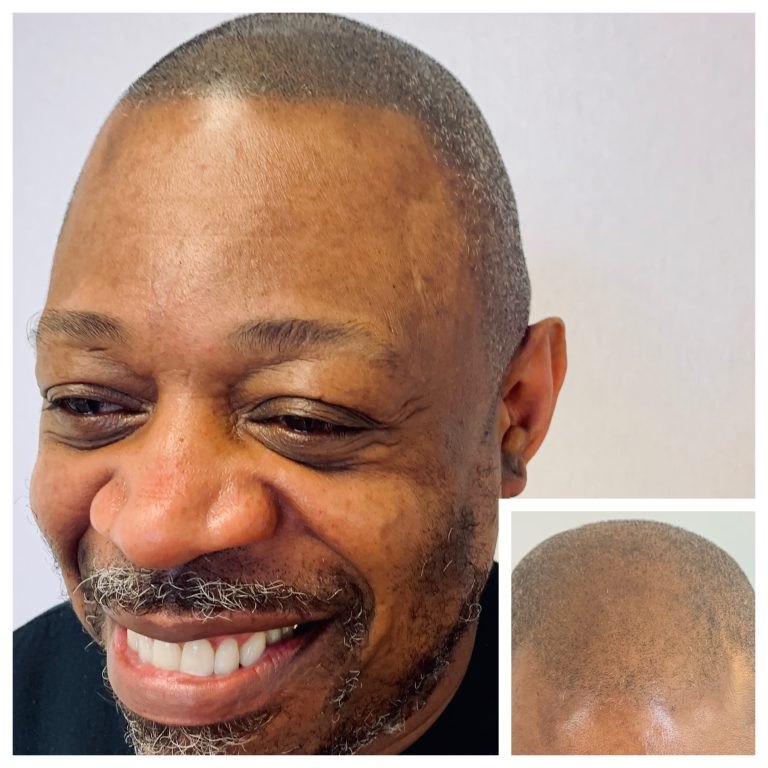
Your skin tone helps me choose the undertone and depth of pigment, but it is not the only factor. I also match the color to your current hair follicle color, consider existing hair and grey, and assess how the pigment looks against your scalp in different lighting. The goal is a soft, natural follicle effect.
Why does skin tone matter when choosing SMP pigment?
Skin tone affects how color is seen through the skin. Two people can have similar hair colors but different undertones, such as warm, cool, neutral, or olive. The same pigment may therefore appear softer on one scalp and more noticeable on another.
I look at your skin tone as part of a broader color assessment. I am not trying to match the surface of your scalp with a flat color. I am choosing a pigment that creates the appearance of individual hair follicles and sits naturally beside your complexion.
SMP can be performed on all ethnicities. A darker or lighter complexion does not rule out treatment, and there is no single pigment shade that suits everyone within any ethnic group. Your individual skin, hair, and scalp need to be assessed together.
How is SMP ink color matched to skin, and how does pigment matching work for a scalp tattoo?
The ink color used in scalp micropigmentation is chosen to match your current hair follicle color. I assess the hair that is present, including shaved hair, thinning hair, or the remaining hair around an area of loss. I also consider whether your hair includes grey, because a pigment that is too dark may look disconnected from naturally silvering hair over time.
Skin undertone is the next part of the match. A warm, peach-toned scalp may need a different blend from a cool, pink-toned scalp, even when the hair appears to be the same shade. Olive undertones bring another consideration. I use my experience with color and visual balance to judge the result rather than relying on a name such as black, brown, or grey.
Lighting matters as well. I assess the color under more than one lighting condition because a tone can look different in a treatment room, outdoors, and beside your existing hair. This is especially important for clients with very light hair, blonde hair, red undertones, or a combination of colors.
Will the pigment look different after healing?
Yes. Fresh SMP can look stronger immediately after a session. As the scalp heals, the pigment settles and the appearance becomes softer. I plan the treatment gradually so I can see how your skin is accepting the color before adding more definition.
SMP places pigment into the epidermal and upper dermal layers rather than deeper tissue. This helps limit noticeable spread and supports a natural-looking follicle effect. Placement depth, dot size, spacing, and pigment selection all influence how the final color is perceived.
Color can also be affected by sun exposure and changes in your own hair. I will explain aftercare during your appointment, including the importance of protecting the treated scalp from prolonged sun exposure. If your hair later becomes more grey, the balance between the pigment and your natural hair may change, and future maintenance can be discussed.
A cautious, staged approach is important. A full treatment usually requires three to four sessions of about two hours each. Female SMP and male density always take a minimum of three sessions, sometimes four. Each appointment gives me an opportunity to assess healing and refine the tone, density, and design.
Does skin tone affect SMP for thinning hair, scars, or alopecia?
It can affect the visual balance, but the matching process remains individualized. For female pattern hair loss or diffuse thinning, I usually need to create the appearance of density without making the scalp look heavily shaded. The relationship between your remaining hair, scalp tone, and pigment is particularly important. You can read more about SMP for female pattern hair loss and diffuse thinning.
For a shaved result, the pigment needs to sit naturally beneath or beside the short hair. The hairline should also suit your facial structure and look softer than a drawn line. When choosing a practitioner, I recommend paying close attention to healed hairline work, not only fresh treatment photographs.
Scar tissue can accept pigment differently from surrounding scalp, so I assess those areas separately. SMP can help conceal the visual impact of scars, but the final approach depends on the scar and the surrounding hair.
Alopecia can involve larger or irregular areas, which makes consistency and blending important. I discuss the pattern of loss, the areas you want addressed, and the level of coverage that will look appropriate with your skin and hair. More information is available in my guide to SMP for alopecia.
What should I ask before choosing a pigment color?
At consultation, ask how the pigment will be matched to your current hair follicle color and skin undertone. Ask to see healed work on clients with a similar hair color or complexion where possible. Fresh results do not show the settled appearance, so healed examples are more useful when judging color and dot definition.
You can also ask whether a small patch test will be performed on an inconspicuous area. A patch test can help identify an ink allergy before full treatment. Carbon-based pigments (CI 77266) rarely cause reactions, so it is worth discussing whether testing is needed in your case.
It is reasonable to ask what happens if your hair becomes lighter or greyer. SMP is intended to be permanent, although it can later be removed with laser treatment. That does not make color selection something to rush. The better approach is to choose a tone that reflects your current hair and can remain visually believable as your appearance changes.
I provide scalp micropigmentation in Oak Brook, Illinois, serving clients from the Chicago area. My background in makeup, photography, and color work informs how I assess tone, contrast, and the way a result reads in real life rather than only in a photograph. You can also browse my scalp micropigmentation knowledgebase before your consultation.
If you are considering SMP, I invite you to book a consultation so we can assess your skin tone, hair color, and goals together.
Frequently asked questions
Can my pigment be matched if I have blonde or red hair?
Yes. Blonde and red hair often require a more careful assessment because the follicle color may include several tones. I look at your current hair, undertone, and scalp contrast rather than choosing a generic light shade. The final blend should support the appearance of natural follicles without creating a harsh block of color.
Will SMP pigment match my skin tone exactly?
The aim is not to make the pigment identical to your skin. A pigment that exactly matches the scalp would not create convincing follicle definition. Instead, I select and place a tone that relates naturally to your skin undertone and current hair color, with small impressions that soften as the scalp heals.
Can I have SMP if my skin changes color in the sun?
You can still be considered for SMP, but sun exposure is part of the planning conversation. Your scalp may look different when tanned, and ultraviolet exposure can contribute to fading. I assess your usual skin tone, explain scalp protection after treatment, and we can discuss how a temporary tan should factor into the choice.
Is a darker pigment better for creating more density?
Not necessarily. A pigment that is too dark can look disconnected from your hair and complexion, particularly when the result is intended to resemble short follicles. Density comes from the arrangement, spacing, and gradual layering of impressions as well as color. I build the result progressively rather than relying on excessive darkness.
What if I dislike the pigment color after treatment?
The color is assessed gradually because fresh SMP is not the final healed appearance. If a concern remains, it should be discussed before additional sessions so the plan can be adjusted. SMP is intended to be permanent, although laser removal is possible later, so careful consultation and conservative color selection matter.